
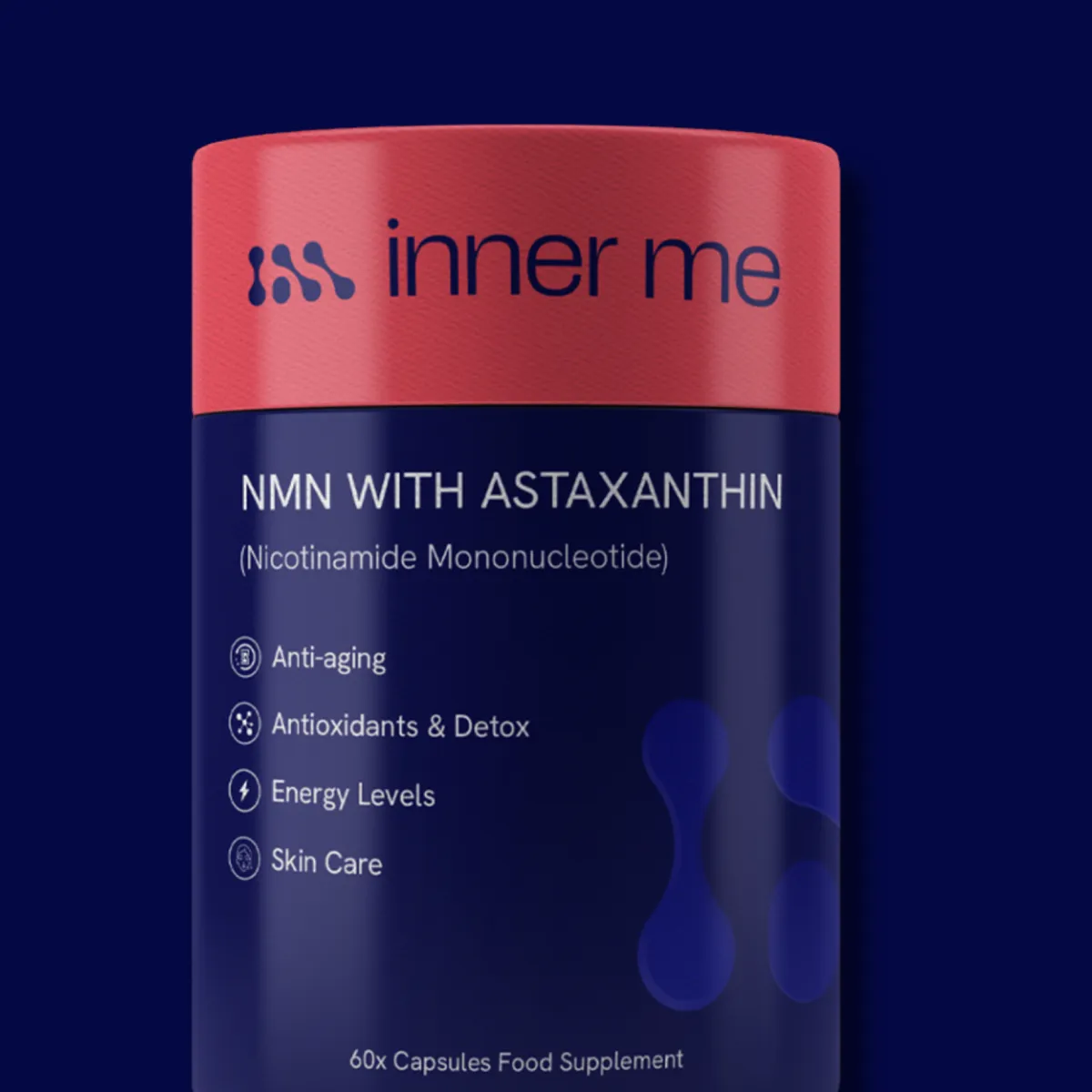
NMN
Restore the cellular fuel that declines with every passing decade

NAD+ Restoration
Cellular Energy
Mitochondrial Function
Logevity Support
NAD+ Restoration
Cellular Energy
Mitochondrial Function
Logevity support
NMN is an age-gated product — recommended for Inner Me clients aged 40 and above where the physiological decline in NAD+ is clinically meaningful. It is particularly relevant for clients presenting with longevity panel flags, multiple markers of metabolic ageing (elevated TG, HbA1c, hsCRP), or those reporting age-related energy decline, reduced aerobic capacity, and slower recovery. Human clinical trials have confirmed NMN reliably raises blood NAD+ levels, improves physical performance metrics, reduces LDL cholesterol and body weight, and improves subjective health scores — with an excellent safety profile at doses up to 900 mg/day.
NAD+ is not a single-function molecule — it is the master currency of cellular metabolism. It accepts and donates electrons in the mitochondrial electron transport chain (generating ATP), serves as the substrate for sirtuins (the longevity enzymes that regulate DNA repair, inflammation, and metabolism), fuels PARPs (the DNA repair polymerases), and powers CD38 and CD157 (immune cell signalling enzymes). When NAD+ declines — as it inevitably does from the fourth decade of life — sirtuin activity falls, DNA repair slows, mitochondrial function deteriorates, and the molecular hallmarks of ageing accelerate. NMN is converted to NAD+ within cells via the enzyme NMNAT, bypassing the rate-limiting NAMPT step of the conventional NAD+ salvage pathway.
Key Ingredients
NMN (β-Nicotinamide Mononucleotide)500 mg / day
NMN is a nucleotide derived from ribose and nicotinamide. It is the immediate precursor to NAD+ in the Preiss-Handler and salvage biosynthesis pathways. Upon oral ingestion, NMN is absorbed by intestinal cells via the Slc12a8 transporter and converted to NAD+ by the NMNAT family of enzymes — bypassing NAMPT, the rate-limiting enzyme in conventional NAD+ synthesis whose activity declines with age and in metabolic disease. The resulting increase in intracellular NAD+ activates three key enzyme families: (1) Sirtuins (SIRT1–7) — NAD+-dependent deacetylases that regulate gene expression, stress responses, mitochondrial biogenesis, inflammation suppression via NF-kB, and DNA repair. SIRT1 activity in particular is strongly linked to longevity pathways in every model organism studied. (2) PARPs (Poly-ADP-Ribose Polymerases) — NAD+-consuming enzymes that repair single and double-strand DNA breaks. Declining NAD+ means slower, less effective DNA repair — contributing to genomic instability, a primary hallmark of ageing. (3) CD38/CD157 — NAD+-consuming enzymes involved in immune cell signalling and calcium mobilisation. Elevated CD38 activity with age is a major driver of NAD+ depletion independent of biosynthesis decline. NAD+ also supports mitochondrial function by maintaining the NADH/NAD+ redox ratio required for efficient electron transport and ATP production — declining mitochondrial NAD+ is a direct cause of age-related energy deficit in muscle, brain, liver, and heart.
Clinical Research
NMN raises blood NAD+ — confirmed across multiple human RCTs
Consistent finding across trials
Dose-dependent RCT — blood NAD+ elevation, physical performance & health scores (n=80)
PubMed ID: 36482258 · Yi et al. · GeroScience (2023) · n=80 · 300, 600, 900 mg/day · 60 days · NCT04823260
NMN supplementation at all three doses (300, 600, 900 mg/day) significantly increased blood NAD+ concentrations versus placebo. Clinical efficacy on blood NAD+ and physical performance (6-minute walking test) peaked at 600 mg/day. All three NMN groups showed statistically significantly better SF-36 health scores versus placebo at day 30 and day 60 (p<0.05) — indicating improved subjective health and wellbeing. NMN was safe and well tolerated up to 900 mg/day.
RCT — NMN maintains walking speed and improves sleep quality in older adults (n=60)
PMC11336149 · Saito et al. · AGE (2024) · n=60 · 250 mg/day · 12 weeks · UMIN000047871
After 12 weeks, the NMN group had a significantly shorter 4-metre walking time than the placebo group — while the placebo group's walking speed significantly declined over the same period (p<0.001). Blood NAD+ and its metabolites were significantly higher in the NMN group. The NMN group also showed significantly improved sleep quality (lower Daytime Dysfunction and Global PSQI scores). A significant negative correlation was observed between the change in walking time and the change in blood NAD+ levels — directly linking NAD+ restoration to physical function maintenance.
RCT — NMN reduces LDL, body weight, and diastolic blood pressure in middle-aged adults
Double-blind, placebo-controlled · n=36 healthy middle-aged participants · 125 mg twice daily · 12 weeks
NMN supplementation significantly reduced total LDL cholesterol, non-HDL cholesterol, body weight, and diastolic blood pressure. Arterial stiffness was reduced, suggesting NMN supplementation potentially improves vascular health in middle-aged adults. NMN intervention specifically reduced diastolic blood pressure in participants with higher-than-mean blood glucose levels — suggesting particular benefit in metabolically challenged individuals.
RCT — NMN enhances aerobic capacity in amateur runners
J Int Soc Sports Nutr (2021) · PubMed ID: 34238308 · Randomised, double-blind · 300 mg/day · 12 weeks
NMN supplementation (300 mg/day for 12 weeks) significantly improved aerobic capacity versus placebo in healthy adult runners — increasing VO2 max and endurance on the treadmill test. Blood NAD+ levels rose substantially, confirming bioavailability. Aligns with rodent data showing NMN increases muscle NAD+ and SIRT1 activity, enhancing mitochondrial function and fatigue resistance.
Evidence quality note: NAD+ elevation in humans is consistently confirmed across multiple RCTs — this is not in doubt. Physical performance benefits (walking speed, aerobic capacity, muscle function) are now supported by multiple positive RCTs in older adults. However, two meta-analyses (PMC11557618; PubMed 39116016) found no significant overall effect of NMN on fasting glucose, HbA1c, or lipid profiles across all trials reviewed — suggesting metabolic benefits may be most pronounced in those with elevated baselines rather than healthy adults. The 500 mg dose in this formula is within the range of doses showing positive physical performance and NAD+ elevation results. NMN is currently restricted as a dietary supplement in the US following FDA drug designation — it remains legally available as a supplement in the UK and Europe.
NAD+ biology — the case for supplementation in ageing Mechanistic evidence — very strong
NAD+ declines ~60% from early to late adulthood across multiple tissues
Multiple population studies · Plasma, skin, liver, and muscle NAD+ measured across age groups
Plasma NAD+ concentrations decline approximately 60% from early to late adulthood, with parallel declines in skin, liver, and muscle tissue. This systemic reduction limits the activity of sirtuins — the longevity-linked enzymes that regulate stress responses, metabolic efficiency, and DNA repair. Healthy ageing and muscle function are positively associated with NAD+ abundance in humans (Janssens et al.), providing direct human correlational evidence for the importance of maintaining NAD+ levels.
Sirtuins, PARPs, and longevity — the NAD+ consumer enzymes
Multiple mechanistic reviews · Song et al. Advances in Nutrition (2023) · PubMed ID: 37619764
Sirtuins use NAD+ to perform deacetylation reactions that regulate gene expression, mitochondrial biogenesis, and inflammation suppression. SIRT1 activation is linked to improved lifespan and healthspan in every model organism studied. PARPs consume NAD+ during DNA repair — declining NAD+ means declining DNA repair capacity, directly contributing to genomic instability. CD38 (an immune enzyme whose activity increases with age) is the largest single consumer of NAD+ in the ageing body, representing a "NAD+ leak" that outpaces biosynthesis. NMN bypasses the rate-limiting NAMPT step to directly restore the NAD+ available to all three enzyme systems.
Blood Marker Triggers
Longevity Risk
Primary for 40+ clients when the full longevity panel is flagged. NAD+ declines ~60% by late adulthood — NMN is the most direct oral intervention for restoring it. Age 40+ is the minimum threshold for recommendation.
Fatigue & Burnout Risk
Secondary for 40+ clients when cortisol, Free T3, ferritin, and B12 are flagged. Cellular energy production depends on adequate NAD+ — declining NAD+ directly impairs mitochondrial ATP output in muscle, brain, and liver.
Cardiometabolic Longevity Risk
Secondary for 40+ when TG, HDL, LDL, HbA1c, and hsCRP are all flagged. Human RCTs confirm NMN reduces LDL, total cholesterol, body weight, and diastolic blood pressure — particularly in those with higher baseline glucose.
Overtraining / Athletic Recovery
Secondary for active 40+ clients with elevated cortisol and poor recovery. NMN improves VO2 max and walking speed in human RCTs — the muscle NAD+-SIRT1 axis is a key driver of mitochondrial adaptation to exercise.
Neurological Function Risk
Tertiary for 40+ clients when B12 and folate are flagged. SIRT1 activation via NAD+ drives neuroprotection, DNA repair in neurons, and mitochondrial function in the brain — directly relevant to age-related cognitive decline.
Biological Age Elevated
Direct trigger for clients where longevity panel assessment suggests accelerated biological ageing. Yi et al. (GeroScience 2023, n=80) found all NMN doses produced significantly better SF-36 health scores than placebo — consistent with biological age improvement.
User Guidance
1.
Take 500 mg (1 capsule) in the morning, with or without food. Morning dosing aligns with the circadian peak of NAD+ metabolism. Consistent daily use is essential — NAD+ elevation is a cumulative process that requires weeks of supplementation to produce meaningful changes.
2.
Allow a minimum of 8–12 weeks before assessing benefit. Physical performance improvements in RCTs were observed at the 12-week timepoint. The 500 mg dose is within the range showing physical performance and NAD+ elevation in positive trials (300–900 mg range).
3.
NMN is an age-gated product — recommended for 40+ clients only. NAD+ decline is modest in younger adults and the cost-benefit ratio is most favourable when the physiological decline is clinically meaningful. Recommend CoQ10 as an alternative for under-40 clients with energy concerns.
4.
NMN pairs well with CoQ10 as a longevity energy stack — NMN restores the NAD+ driving sirtuin activity while CoQ10 directly supports mitochondrial electron transport. Together they address two distinct but complementary arms of cellular energy decline with ageing.
Legal Disclaimer
Legal disclaimer: This product is a food supplement and is not intended to diagnose, treat, cure, or prevent any disease or medical condition. Do not exceed the recommended daily dose. Not suitable for children or adults under 40 years of age without practitioner guidance. Do not use if pregnant or breastfeeding without medical advice. Consult a qualified healthcare professional before use if you have a diagnosed medical condition, take prescription medications, or are undergoing cancer treatment — NAD+ supplementation may theoretically influence cell proliferation pathways. This product has not been evaluated by the MHRA or FDA as a drug. The regulatory status of NMN as a dietary supplement varies by jurisdiction. Food supplements should not be used as a substitute for a varied diet and a healthy lifestyle. Store in a cool, dry place away from direct sunlight and out of reach of children. Made in the UK by Feel Supreme Retail Ltd, 72, L34 5QL. inner-me.org

Contact Us
07834 412345
Office 1, Brunswick House, Brunswick Way, Liverpool England L3 4BN